学习率Learning Rate
Learning Rate
控制每次参数更新的步长,是训练中最敏感的超参数之一。Set the step size of each parameter update; one of the most sensitive hyperparameters in training.
太大容易震荡或发散,太小收敛慢甚至卡在平台。
常见策略包括 warmup、余弦退火、按验证集表现衰减。
Too large causes oscillation or divergence; too small converges slowly or stalls on a plateau.
Common schedules include warmup, cosine decay and reducing on validation performance.
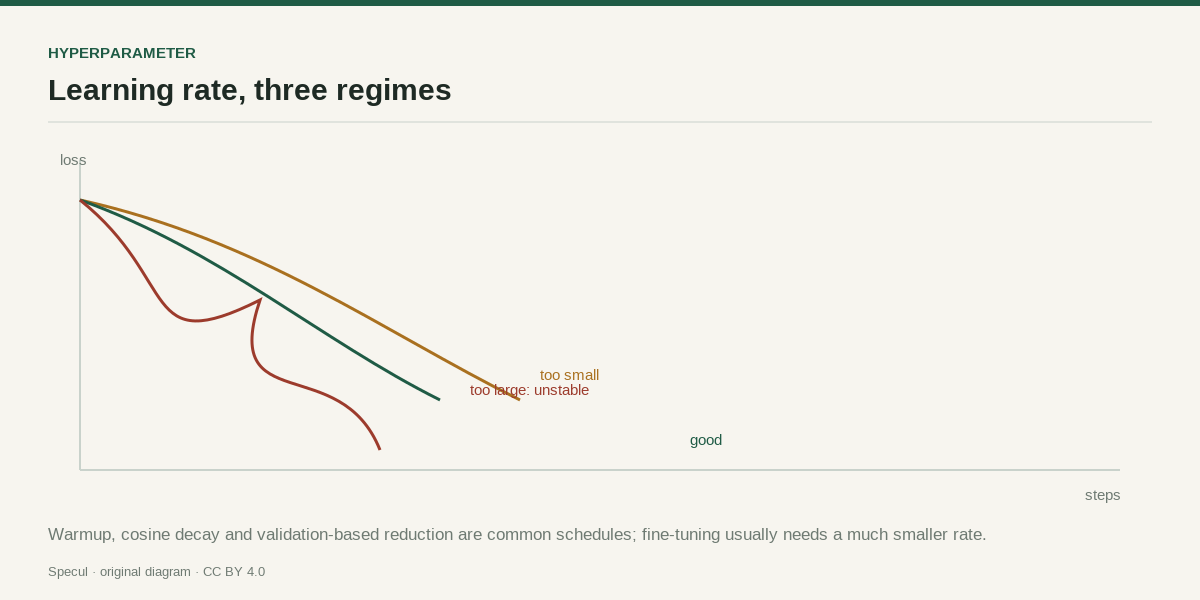
换批大小、换优化器、做微调都要重新考虑学习率。微调通常比预训练小几个数量级。Changing batch size, optimizer or fine-tuning regime means reconsidering the learning rate. Fine-tuning usually uses rates orders of magnitude smaller than pretraining.
lr · 步长 · learning rate
回到名词地图看第4段的其他 60 个词 →Back to the map: the other 60 terms in stage 4 →
别停在定义:去任务手册看按什么顺序做、验收什么;或者按你手头的任务,筛 3 个工具候选。Don’t stop at the definition: use the task handbook for the order and checks, or filter three tool candidates for the job at hand.
任务手册 →Task handbooks → · 按任务筛 3 个候选 →Filter three candidates →