重排(Reranking)Reranking
Reranking
在初步召回的一批候选里,用更精细的模型重新排序,把真正相关的几条排到最前面。Reorder a small candidate set with a more precise model so the genuinely relevant passages reach the top.
检索系统通常先做召回(向量或关键词),再用交叉编码器逐对打分。
重排模型同时读查询和候选文本,算得慢但更准,所以一般只用在几十到两百条候选的小集合上。
Retrieval systems usually recall first (vector or keyword search), then score query-passage pairs with a cross-encoder.
A reranker reads both the query and the passage; it is slower but more accurate, so it runs only on tens to a couple of hundred candidates.
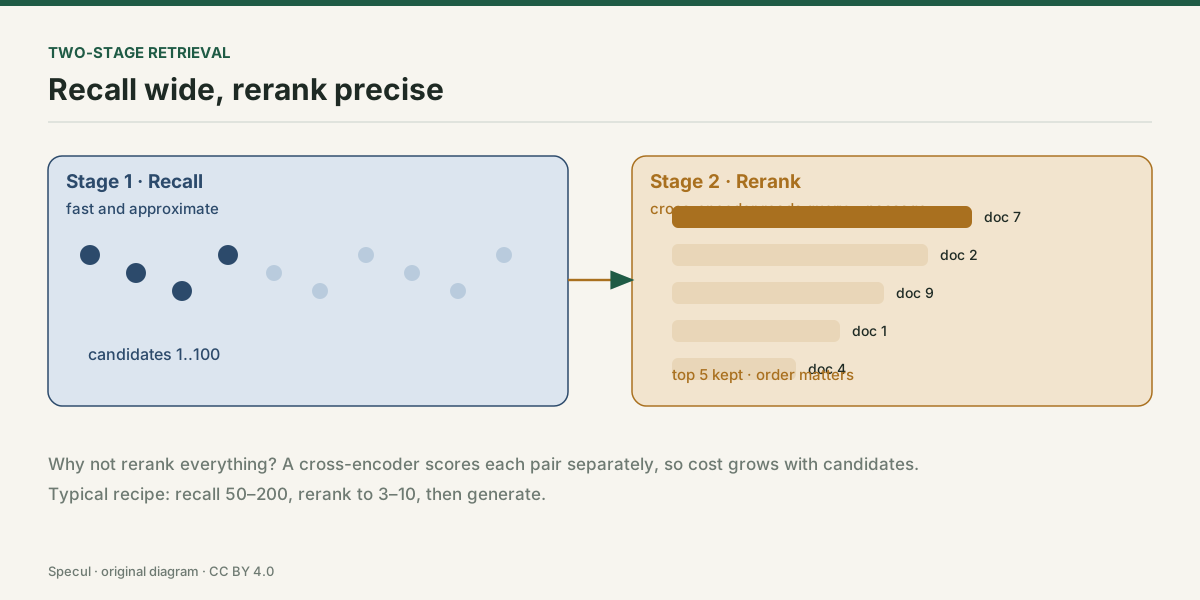
只靠向量相似度,顺序常常不理想;加一层重排通常能明显提升引用质量,代价是延迟和算力。Vector similarity alone often produces a mediocre order. A reranking layer usually improves citation quality, at the cost of latency and compute.
重排序 · rerank · 交叉编码器重排
回到名词地图看第3站的其他 54 个词 →Back to the map: the other 54 terms in station 3 →