思维链Chain of Thought (CoT)
Chain of Thought (CoT)
让模型先列推理步骤再给答案的提示方式,以及它对模型规模的依赖。Prompting the model to lay out reasoning steps before answering — and its dependence on model scale.
Wei 等人提出:在示例中给出若干中间推理步骤,可显著提升足够大的模型的推理表现。
PaLM 540B 仅用 8 个思维链示例。它在 GSM8K 数学题上达到当时最优。
该文同时指出思维链是规模的涌现能力:约 10B 以下的小模型上反而降低性能。
小模型会产出「流畅但无逻辑」的推理链。
Wei et al. showed that a few chain-of-thought exemplars markedly improve reasoning in sufficiently large models.
PaLM 540B with just eight exemplars reached state-of-the-art accuracy on the GSM8K math benchmark.
The same paper shows CoT is an emergent ability of scale: it hurts models below roughly 10B parameters.
Small models produce fluent but illogical chains of thought.
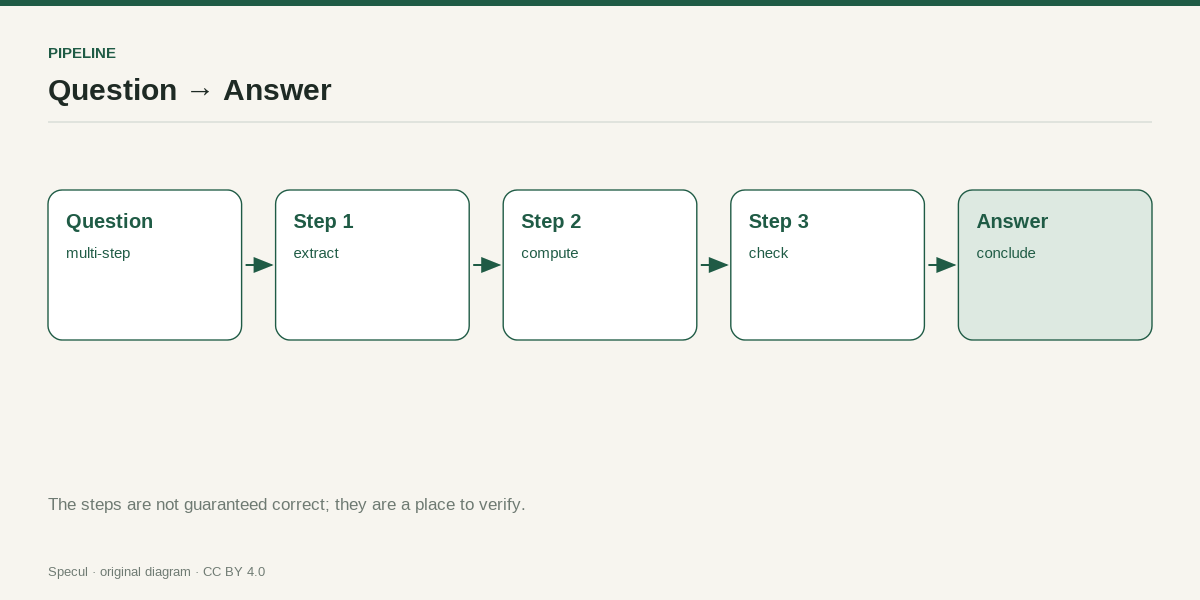
「让模型一步步想」对小模型可能有害。知道规模门槛,才知道这招什么时候该用、什么时候是自我安慰。'Make the model think step by step' can backfire on small models. Knowing the scale threshold tells you when the trick works and when it is self-comfort.
看站群怎么分工:这一站回答「是什么」,其他站回答「选哪个」How the site family divides the work ↗
回到名词地图看第4段的其他 60 个词 →Back to the map: the other 60 terms in stage 4 →
- Wei 等《Chain-of-Thought Prompting Elicits Reasoning in Large Language Models》Wei et al., Chain-of-Thought Prompting (NeurIPS 2022) ↗
别停在定义:去任务手册看按什么顺序做、验收什么;或者按你手头的任务,筛 3 个工具候选。Don’t stop at the definition: use the task handbook for the order and checks, or filter three tool candidates for the job at hand.
任务手册 →Task handbooks → · 按任务筛 3 个候选 →Filter three candidates →