视觉语言模型(VLM)Vision-Language Model (VLM)
Vision-Language Model (VLM)
同时理解图像和文字,能看图回答问题或按文字描述处理图片的模型。A model that understands images and text together, answering questions about images or acting on text instructions.
VLM 通常由视觉编码器把图片变成向量,再与文本 token 一起送入语言模型。
CLIP 用 4 亿图文对做对比学习,证明了自然语言可以作为视觉概念的接口。
A VLM usually uses a vision encoder to turn an image into vectors, then feeds them with text tokens into a language model.
CLIP trained on 400 million image-text pairs with contrastive learning, showing natural language can serve as an interface to visual concepts.
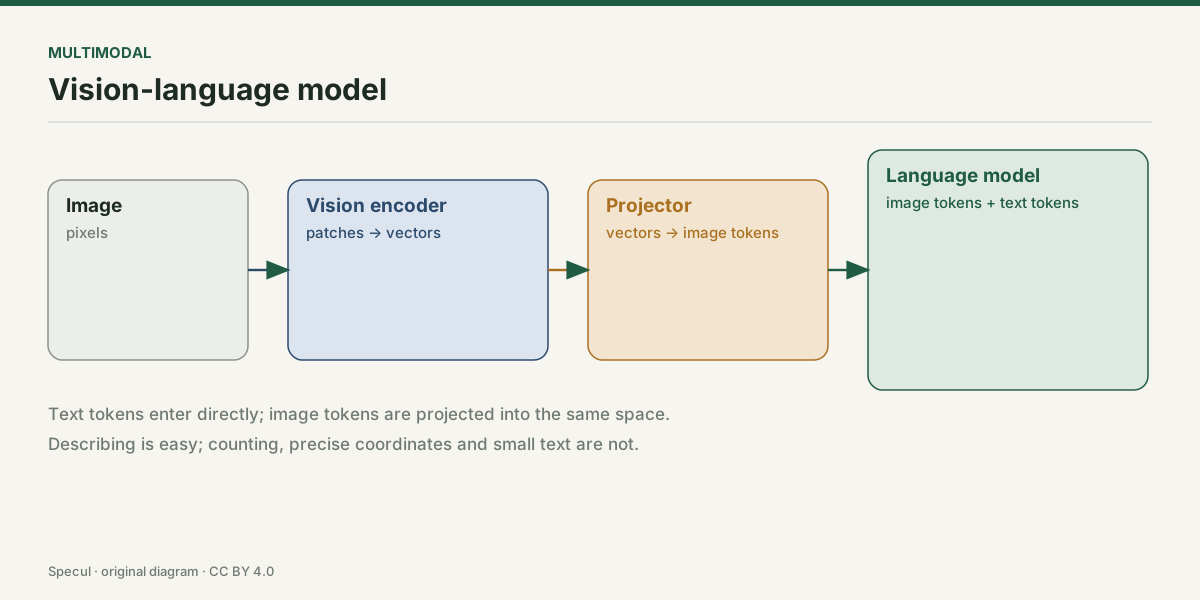
票据、截图、图表、质检都靠它;但「看图说话」不等于精确测量,细节与文字仍需专门模型。Receipts, screenshots, charts and inspection all rely on it. But describing an image is not precise measurement; fine detail and text may still need dedicated models.
VLM · 多模态模型 · 视觉语言模型
回到名词地图看第4站的其他 46 个词 →Back to the map: the other 46 terms in station 4 →