Vision-Language Model (VLM)
Vision-Language Model (VLM)
What problem it solves
A model that understands images and text together, answering questions about images or acting on text instructions.
What it is
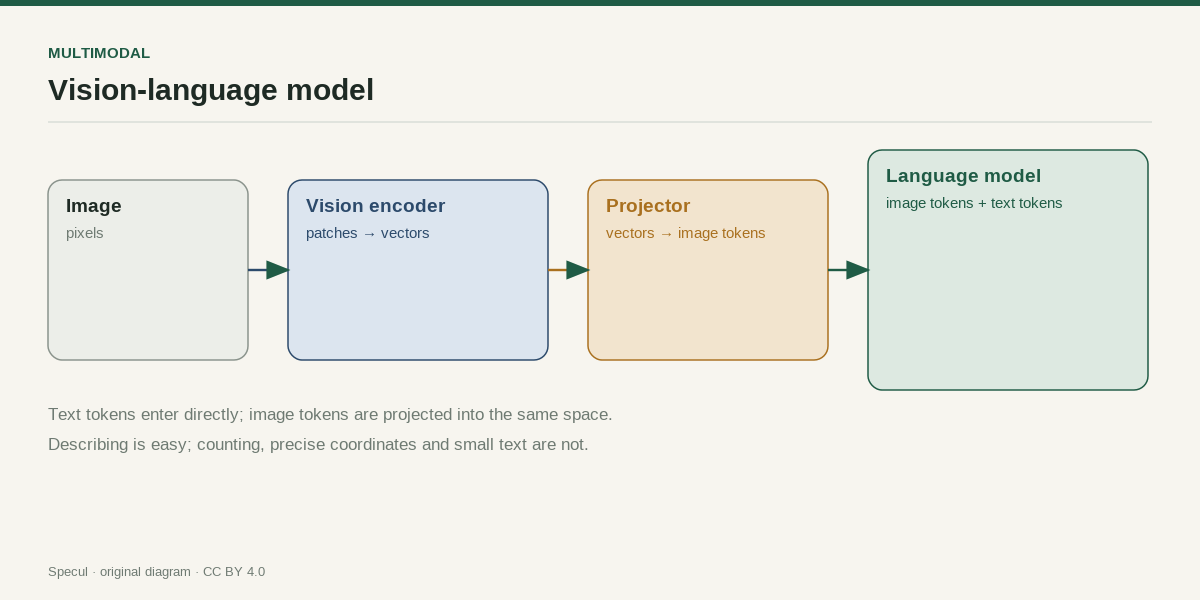
A VLM usually uses a vision encoder to turn an image into vectors, then feeds them with text tokens into a language model.
CLIP trained on 400 million image-text pairs with contrastive learning, showing natural language can serve as an interface to visual concepts.
Why it matters
Receipts, screenshots, charts and inspection all rely on it. But describing an image is not precise measurement; fine detail and text may still need dedicated models.
Chinese aliases
What you can do now
Models atlas: which quantisations exist and which tier fits your VRAM ↗
Sources
Use this term in a task
Don’t stop at the definition: use the task handbook for the order and checks, or filter three tool candidates for the job at hand.