Text-to-Image Generation
Text-to-Image Generation
What problem it solves
Typing turns into pictures: diffusion's most visible application — practical only after moving from pixel space to latent space.
What it is
Early diffusion models denoised directly in pixel space, costing hundreds of GPU-days to train.
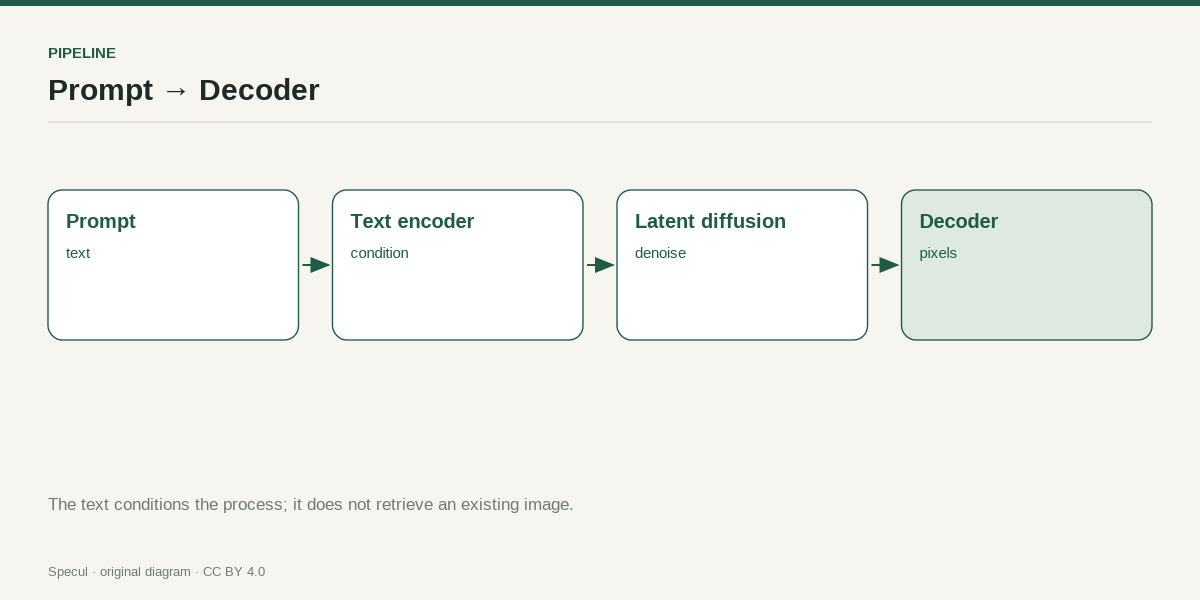
The latent diffusion paper moved diffusion into the latent space of a pretrained autoencoder, slashing training and inference cost.
Adding cross-attention let text and other conditions guide generation — making text-to-image work.
That paper, the basis of Stable Diffusion, was published at CVPR 2022.
Why it matters
'Type a sentence, get a picture' is not magic but this architecture stack. Knowing the latent-space step explains why it is affordable where early approaches were not.
Related guides
What you can do now
Models atlas: which quantisations exist and which tier fits your VRAM ↗
Sources
- Rombach et al., High-Resolution Image Synthesis with Latent Diffusion Models (CVPR 2022) ↗
Use this term in a task
Don’t stop at the definition: use the task handbook for the order and checks, or filter three tool candidates for the job at hand.