LoRA (Low-Rank Adaptation)
LoRA (Low-Rank Adaptation)
What problem it solves
Budget fine-tuning: freeze the original weights, train only a small 'patch'.
What it is
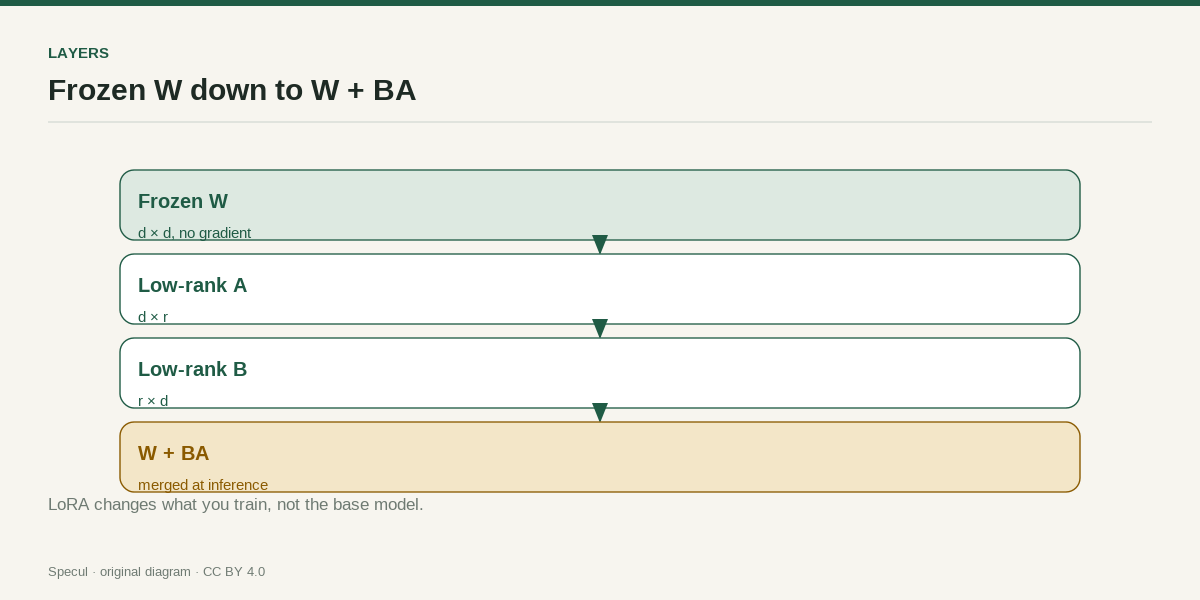
LoRA freezes pre-trained weights and injects trainable low-rank decomposition matrices into each layer.
Versus full fine-tuning of GPT-3 175B: about 10,000x fewer trainable parameters and roughly 3x less GPU memory.
After training the low-rank matrices can be merged into the weights, adding no inference latency.
Many community fine-tunes trained on consumer GPUs use it.
Why it matters
LoRA is the watershed that made 'fine-tune on your own GPU' routine. It is the default starting point when choosing a fine-tuning approach.
Terms in the same area
What you can do now
Models atlas: which quantisations exist and which tier fits your VRAM ↗
Sources
- Hu et al., LoRA: Low-Rank Adaptation of Large Language Models (2021) ↗
Use this term in a task
Don’t stop at the definition: use the task handbook for the order and checks, or filter three tool candidates for the job at hand.