Reranking
Reranking
What problem it solves
Reorder a small candidate set with a more precise model so the genuinely relevant passages reach the top.
What it is
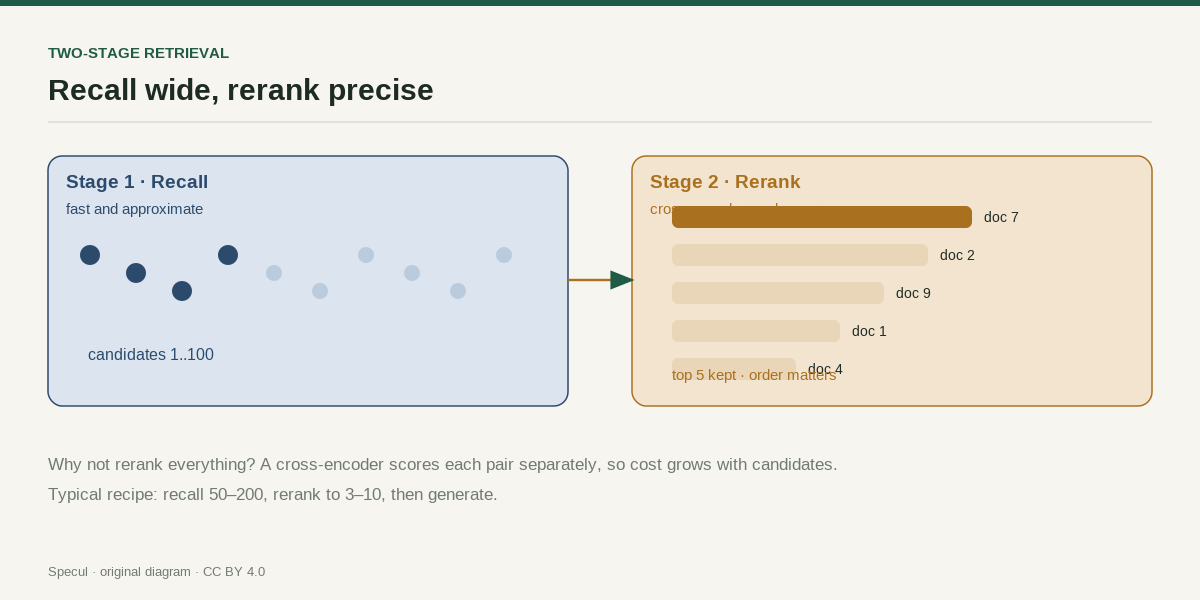
Retrieval systems usually recall first (vector or keyword search), then score query-passage pairs with a cross-encoder.
A reranker reads both the query and the passage; it is slower but more accurate, so it runs only on tens to a couple of hundred candidates.
Why it matters
Vector similarity alone often produces a mediocre order. A reranking layer usually improves citation quality, at the cost of latency and compute.
Chinese aliases
Terms in the same area
What you can do now
Models atlas: which quantisations exist and which tier fits your VRAM ↗
Use this term in a task
Don’t stop at the definition: use the task handbook for the order and checks, or filter three tool candidates for the job at hand.